The Inference Layer Decision Most Teams Get Backwards
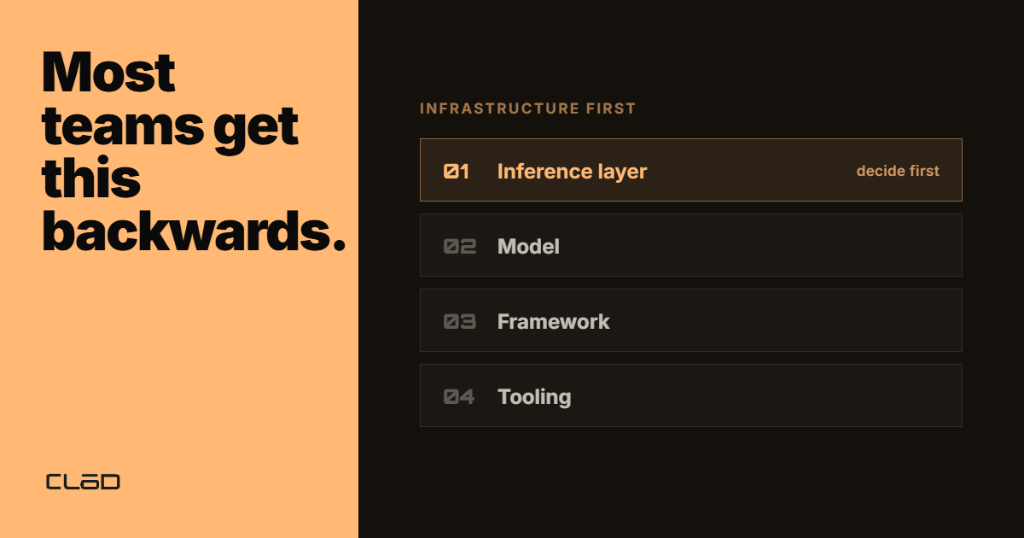
Most teams pick the model first and the inference layer last. That sequence produces the worst unit economics — and a re-architecture project waiting to happen.
There's a sequence to how most AI teams make their infrastructure decisions, and it tends to go in the wrong order.
First: pick a model. GPT-4o, Claude, Gemini — the model selection conversation gets the most attention, the most benchmarking, the most deliberate evaluation. Second: pick a framework. LangChain, LlamaIndex, AutoGen — the orchestration layer gets evaluated carefully. Third: pick tooling. IDE plugins, CI/CD integrations, monitoring. Then, last — almost as an afterthought — the inference layer. Whatever API key you've already got. Whatever the quickest path to a working prototype was.
This sequence produces the worst unit economics. Every team that's hit a mid-quarter billing surprise has gone through some version of it.
Why the Sequence Matters
The inference layer is not just where API calls land. It's where the cost structure of your entire AI product is determined.
Which model handles each step in a multi-step pipeline — and at what price — is an inference layer decision. Whether retries are bounded and how retry context is managed is an inference layer decision. Whether your request goes to the cheapest available compute for that task at that moment, or to a fixed endpoint regardless of cost, is an inference layer decision.
These decisions compound with every call. An inference layer chosen thoughtfully before you scale applies the right routing logic to every request from day one. An inference layer chosen last — after the product is built, after the usage patterns are set, after the dependencies are deep — is a re-architecture project waiting to happen.
The teams with the best AI unit economics didn't get lucky. They made the inference layer decision first.
What Infrastructure-First Teams Look Like
Teams that choose their inference layer before their models share a few observable characteristics.
They have per-task cost visibility from the start. They know what a completed workflow costs in tokens, not just what a single API call costs. They modeled the agentic multiplier — the 5× to 30× increase in tokens per task from context accumulation, retries, and tool call overhead — before they hit production volume.
They route intelligently across model tiers. Not every step in an agentic pipeline needs the most expensive model. Classification, intent detection, and intermediate summarization route to free or near-free models. Final synthesis and complex reasoning route to premium ones. This isn't a manual optimization — it's built into the inference layer logic.
They're not exposed to single-provider pricing changes. When a model provider reprices — as is happening increasingly in 2026 as major providers prepare for IPOs and transition away from growth-phase subsidies — their routing adapts automatically. They don't absorb the change; they route around it.
And the compound effect: every call, from the first prototype to the ten-thousandth production request, benefits from the same routing intelligence. The advantage scales with the product.
The Backwards Teams Discover the Problem at Scale
The more common sequence — model first, inference layer last — produces a different outcome.
Everything works fine at prototype scale. The cost is negligible, the routing is simple, the API key is whatever was easiest to get. Then the product scales. Agentic workflows that were cheap at 100 daily tasks become expensive at 10,000. The context accumulation multiplier, invisible at low volume, shows up as a billing surprise at production volume.
Then comes the re-architecture conversation: evaluate alternative models, rethink routing logic, consider a new inference layer, deal with the migration cost and re-testing overhead on a product that's already in production. This is a significantly harder problem than designing the routing layer correctly at the start.
The fintech startup that pays $5K/month with 50 users and $15K/month with 500 users — not the $50K linear extrapolation would suggest, but not the $1K they hoped for either — is discovering that their cost-per-user varies by behavior, not just by headcount. Fixing that at 500 users is tractable. Fixing it at 50,000 users is a different conversation.
The Decision That Compounds
The inference layer decision is the most leveraged infrastructure decision an AI team makes, and it's consistently the last one teams get to.
Changing it early costs an afternoon. Changing it at production scale costs engineering weeks and introduces risk into a live product. The teams that recognized this — and chose an inference layer designed for cost-aware routing, multi-model flexibility, and energy optimization before they needed it — are the ones compounding that advantage with every call.
CLōD is an AI inference platform built to be the first infrastructure decision, not the last. One API. 50+ models. Up to 60% cheaper inference through patented energy-aware routing.
The sequence matters. Starting with the inference layer is the move most teams make too late.
Start free. No credit card required.