The Hidden Variable in Your AI Inference Bill: Where It Actually Runs
Every inference cost conversation starts with token count times model price. But there's a second variable almost nobody optimizes: where in the world your inference actually runs.
Every conversation about AI inference costs starts the same way: token count times model price. Pick a cheaper model, pay less. Use fewer tokens, pay less. It's a straightforward equation, and most teams have gotten good at optimizing it.
But there's a second variable almost nobody talks about. At scale, it matters just as much as the model you choose.
Where in the world your inference runs.
Energy Is the Largest Operating Expense in AI Infrastructure
Running a large-scale AI inference operation involves two categories of cost: capital expenditure on hardware, and ongoing operating expenditure to keep everything running. Hardware dominates the capital picture. But energy — powering the GPUs, cooling the data centers, maintaining the infrastructure — is the largest single operating expense in AI inference infrastructure.
That matters for one reason: operating costs are ongoing. Hardware is a one-time purchase that gets amortized. Energy is a recurring bill, paid every month, tied directly to how much inference gets processed. And unlike hardware, which is largely commoditized across providers, energy prices are not uniform.
They vary dramatically.
The Geography Problem
US commercial electricity rates vary by more than 3x across states. A data center running on low-cost renewable hydropower in the Pacific Northwest pays fundamentally different electricity rates than one drawing from the northeastern grid. A facility powered by cheap wind energy in Texas sits at a different cost point than a coastal facility in a high-demand market.
Globally, the spread is wider. Different countries, different grid compositions, different regulatory environments — the electricity price per kilowatt-hour that underpins AI inference can differ by 4x or 5x depending on where the physical servers sit.
For most inference providers, this geographic variation is invisible to the customer. You pay a token price. The provider handles the infrastructure. Whether your request is processed in a low-cost renewable facility or an expensive urban data center is their problem, not yours. In a competitive market, most providers don't have the incentive or the tooling to route dynamically between regions in real time.
That's the gap CLōD was built to close.
Two Variables, Optimized Together
Standard inference routing asks one question: which model, at what price, for this request?
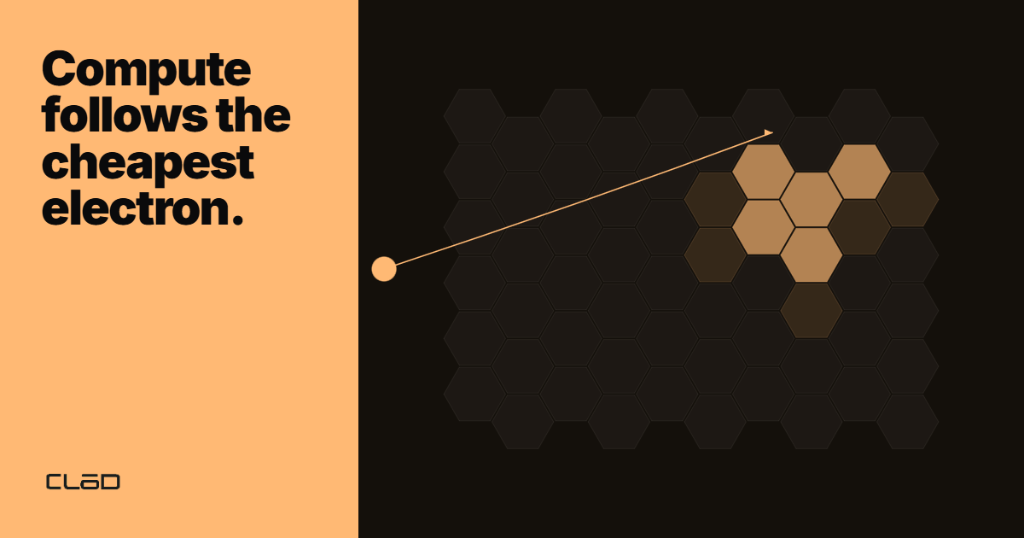
CLōD's energy-aware routing asks two: which model, at what price, running where — at what energy cost — for this request?
The system tracks real-time energy pricing across regions and routes inference to the lowest-cost location that meets the latency requirement for each call. Model cost and energy cost are optimized together, not independently. The result is a compounding effect: CLōD-hosted models already run at up to 60% less than direct provider pricing, and the energy routing layer compounds that further by continuously arbitraging the geographic cost differential.
This is why CLōD holds a patent on energy-aware routing. The technical challenge isn't just knowing where energy is cheap. It's doing the real-time math on latency, model availability, and energy cost simultaneously for every request, at production throughput.
Why This Becomes More Important Over Time
Model pricing is converging. The distance between the most expensive and least expensive capable models has compressed significantly over the past two years, and that trend is accelerating. Open-source models that match proprietary model performance on most tasks are now available and well-supported. The per-token cost gap between providers is narrowing.
As model price convergence continues, the teams with structural cost advantages won't be the ones who found the cheapest model. They'll be the ones who optimized the full cost stack — including the energy layer that most providers leave on the table.
There's a second dynamic worth noting: AI data centers are entering an era of genuine resource competition. The largest cloud providers are signing power purchase agreements and competing for proximity to renewable energy sources as aggressively as they compete for GPU contracts. Data center geography is becoming a strategic asset. The inference providers with diverse, energy-efficient infrastructure won't just have lower costs — they'll have more resilient capacity.
CLōD's energy-aware routing is designed for exactly this environment. As energy markets shift and model prices converge, the routing intelligence that continuously optimizes both variables becomes more valuable, not less.
The Number Most Teams Aren't Tracking
Most engineering teams can tell you their average cost per million tokens. Fewer can tell you what percentage of that cost is attributable to where the inference runs versus which model handles it.
At small scale, the difference is negligible. At production scale — thousands of daily tasks, multiple concurrent agents, high-throughput pipelines — it's a meaningful line item.
The infrastructure decision that shapes your cost curve isn't just which model provider you choose. It's whether the inference layer underneath you is optimizing one variable or two.
CLōD optimizes both. One API. 50+ models. Up to 60% cheaper inference through patented energy-aware routing.
Start free. No credit card required.