Why Your Agentic AI Pipeline Costs 30× More Than You Planned
Token prices have never been lower. Enterprise AI bills have never been higher. Here's the data behind the 30× agentic cost multiplier — and the three levers that control it.
By George Nie, CLōD · June 10, 2026
Token prices have never been lower. Enterprise AI bills have never been higher.
If that sounds like a contradiction, it isn't. It's the central paradox of building AI products in 2026, and almost every team building agents is going to feel it — if they haven't already.
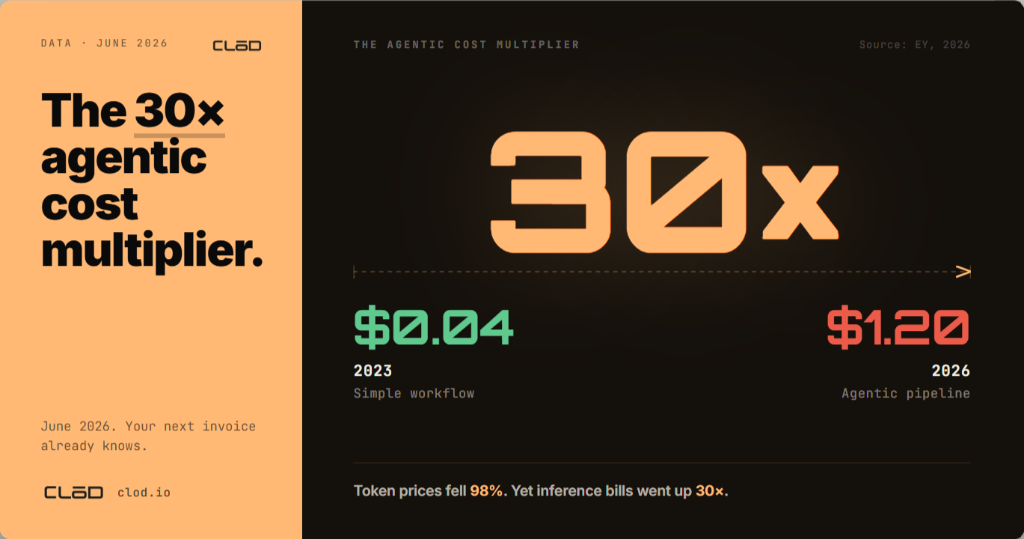
Here's the data: a simple AI workflow interaction cost $0.04 in 2023. The same task running through a modern agentic pipeline today costs $1.20. That's a 30× increase, with token prices falling 98% in the same window. EY published this analysis in 2026, and it lines up exactly with what engineering teams are discovering at their billing cycles.
So what's driving it? Not the models. The orchestration.
The Context Accumulation Problem
When an agent plans a multi-step task, it doesn't just make one call. It makes a call at every step, and at each step it sends its full accumulated context: the system prompt, the conversation history, all intermediate results, all tool call outputs from previous steps.
By step 20, the model has processed the original prompt 20 times.
Add retries (the majority of production agentic systems retry failed calls), tool call results fed back into context, error recovery loops, rate limit backoffs, and subagent orchestration overhead. None of this shows up in your per-token rate. All of it shows up in your bill.
GitHub's engineering team documented this directly:
"When an agent iterates on a problem, it relies on an expanding context window, and every subsequent step requires the system to process the entirety of the previous transaction history, resulting in a compounding token cost."
They noted that if an agent only uses two tools but is initialized with 40, the remaining 38 are pure overhead added to every request.
The Multiplier Is Not Theoretical
Gartner estimates that agentic models require between 5× and 30× more tokens per task than a standard GenAI chatbot, depending on workflow complexity.
Goldman Sachs projects a 24-fold increase in enterprise token consumption by 2030, driven largely by the shift to agentic workloads. The FinOps Foundation's 2026 State of FinOps report found that 73% of enterprises exceeded their AI cost projections this year. This mechanism is the primary reason.
The teams that got surprised were treating their agentic inference budget like a chat completion budget. Different architecture, different cost curve.
The Number Most Teams Haven't Calculated
Here's the math most teams skip before they scale:
Tokens per task × calls per day × concurrent agents running = your actual monthly inference bill
Run it at 1,000 daily tasks with 5 concurrent agents. At $1.20 per interaction, you're at $6,000/day. At $0.04 (the 2023 baseline), it's $200/day. Both numbers are for the same output quality.
The difference is entirely in the orchestration layer: which model handles each step, how much context gets sent, whether retries are bounded, how tool call results are managed.
What Controls It
Three things determine where you land on the 5×–30× multiplier:
1. Model selection per step. Not every step in a multi-step workflow needs your most capable model. Planning, retrieval, and classification tasks can route to cheaper models. Final synthesis routes to the best one. Routing intelligently at the step level — not the workflow level — is where the cost difference compounds.
2. Context management. Long context windows are powerful. They're also expensive at every step. Summarizing intermediate results instead of passing full history, scoping tool initialization to what the task actually needs, and bounding retry context are all mechanical levers with measurable impact.
3. Retry architecture. Unbounded retries on a failed agentic step can multiply a task's token cost by 3–10× on its own. Exponential backoff with hard limits and fallback routing is the difference between a predictable inference bill and a surprise at month-end.
The Inference Layer Is Now a Strategic Decision
The cost to build AI products is falling. The cost to run agentic ones is not following the same curve. That spread is the number every AI PM and engineering lead should be tracking.
The teams winning on unit economics in 2026 didn't stumble into it. They chose an inference layer built for agentic workloads before they scaled — not after. That means routing that responds to model pricing changes automatically, a free tier that lets you validate workflow costs before committing to production, and no surprise upgrades mid-build.
CLōD is an AI inference platform built for exactly this. One API. 50+ models. Up to 60% cheaper inference through patented energy-aware routing. The math that works at 100 users still works at 10,000.
Start free. No credit card required. See your inference cost before you commit.
Sources
- EY: Agentic AI Enterprise Token Cost
- Gartner: Agentic models require 5–30× more tokens than chatbots
- GitHub Blog: Improving token efficiency in GitHub Agentic Workflows
- The Next Web: Token prices fell 98%, enterprise AI bills tripled
- FinOps Foundation 2026 State of FinOps: 73% exceeded AI cost projections
- InfoWorld: The real cost of agentic AI